
“Detecting clinical medication errors with AI enabled wearable cameras”
Conducted by researchers at the University of Washington and Carnegie Mellon University.Read the full peer reviewed paper @ npj Digital Medicine.

“At Operis Health, our ‘Digital Second Check’ isn’t just a concept—it is built upon a foundation of rigorous clinical research. Our core technology was the subject of a landmark study published in npj Digital Medicine (part of the Nature Portfolio), the world’s leading journal for clinical AI.”

Dr. Kelly Michaelsen
Board Certified Anesthesiologist
Summary
Researchers conducted a comprehensive clinical study across 17 real-world operating rooms at two major tertiary medical centers. The team collected and labeled over 400 4K-resolution video sessions of anesthesia providers preparing medications, capturing the complex, high-motion environment of surgical care. Using this dataset, they developed a multi-stage deep learning pipeline consisting of two primary layers: a detector to identify the clinical “intent” (the hands and the medication vial) and a classifier to perform high-resolution optical character recognition on the drug labels. By training the AI to recognize the transition from vial to syringe, the system was able to achieve a 99.6% sensitivity and 98.8% specificity in detecting vial-swap errors, effectively serving as a passive, “always-on” digital second check for clinicians.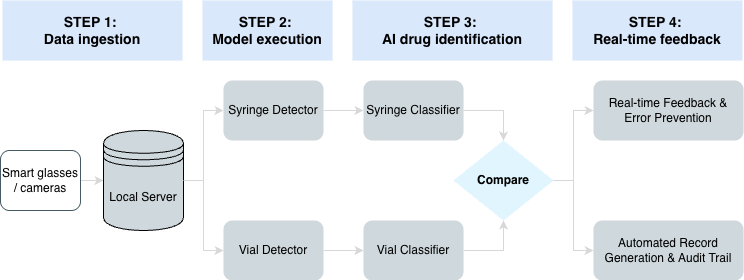
Study Highlights
| Metric | Result | Impact |
|---|---|---|
| Detection Sensitivity | 99.6% | Identifying vial swaps before administration. |
| Detection Specificity | 98.8% | Ensuring high accuracy with minimal “false alarms.” |
| Real-World Testing | 17 ORs | Validated across diverse, high-pressure clinical settings. |
| Data Scope | 424 Sessions | Trained on 4K footage of real clinical workflows. |
Bridging the “Last Mile” of Patient Safety
Current safety protocols (like barcode scanning) are often bypassed in the fast-paced environment of the OR or ICU. The research published in Nature proves that our computer vision system acts as a passive, non-intrusive safety net.Key Technical Findings:
- Vial-to-Syringe Continuity: The AI doesn’t just read a label; it tracks the transition from vial to syringe, closing the “gap” where the majority of medication errors occur.
- Resilience to “Noise”: The model demonstrated high performance despite varying light conditions, motion blur, and obstructed views—common challenges in real-world surgery.
- Low-Latency Feedback: The system is designed to provide alerts in real-time, allowing clinicians to correct an error before the patient is harmed.
Our Research Partners
The technology powering Operis Health was developed and refined through a multi-institutional collaboration between leaders in Medicine and Computer Science:
University of Washington School of Medicine
Carnegie Mellon University
We believe that AI in healthcare must be held to the same standards as any other clinical intervention. Operis Health continues to invest in ongoing technology development and data privacy (HIPAA-compliant) to ensure our platform remains the most trusted name in AI medication safety.